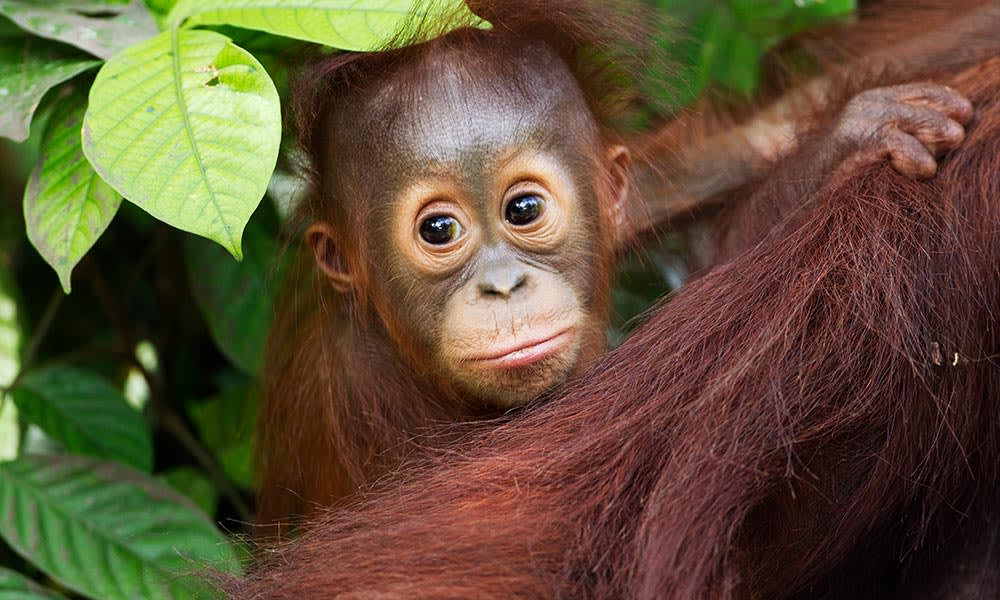
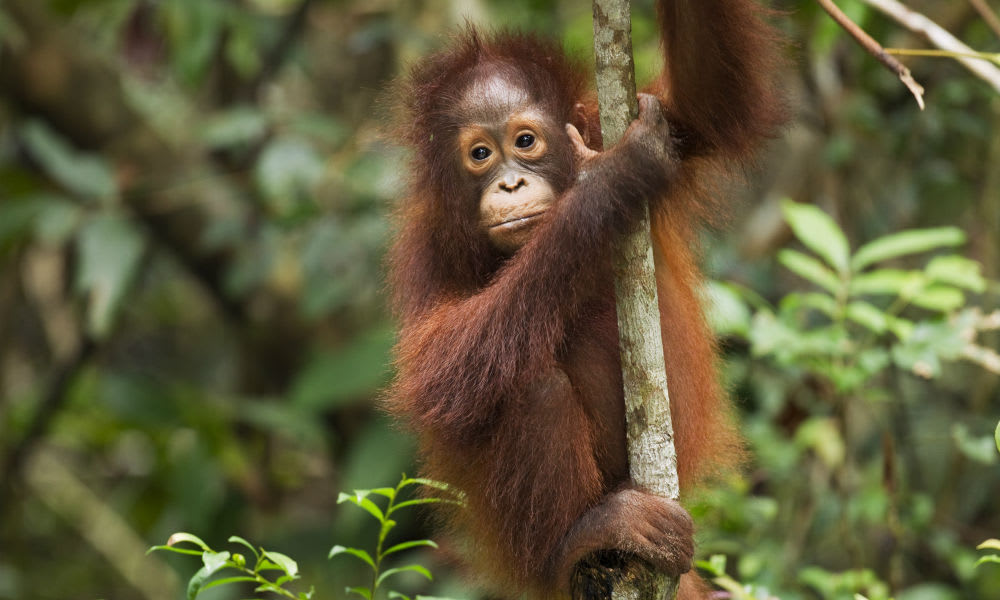
Fairer farming in palm oil production could help protect forests and wildlife.
Irresponsible palm oil production is one of
the biggest threats to orangutans, but a more sustainable system could help protect the forest.
Where ancient, wildlife-rich
forests once stood, now
there’s oil palm as far
as the eye can see.
The
cultivation of this one
crop has led to the loss of natural forests
across Sabah, and today it covers a fifth
of this Bornean state. It also contributes
to climate change – the loss of the forest,
coupled with the churning up of carbon-rich peat soils, releases millions of tonnes
of greenhouse gases into the atmosphere.
Yet oil palm is an extremely efficient
crop – it produces between four and 10
times more oil per land area than other
edible oils such as soyabean, rapeseed and
sunflower. It’s also a vital part of Malaysia’s
economy, and provides thousands of
families with a stable income.
The good news is that palm oil can be
produced more sustainably, in a way that could halt the destruction of the
forest and protect the livelihoods
of local people.
Established in
2004 with the help of WWF, the
Roundtable on Sustainable Palm
Oil (RSPO) aims to make sustainable
palm oil the norm by establishing a
certification system. The guidelines
require producers to meet certain
standards, such as reducing their
impact on the environment, removing
deforestation from their supply chains,
setting aside areas for wildlife and
upholding workers’ rights.
Smallholders can find it challenging
and costly to improve sustainability and
get their certification. To help Sabah’s
state government reach its goal of 100%
RSPO certification by 2025, we’ve been
working with palm oil producers to try
different approaches to group schemes.
These initiatives help reduce the
costs involved in achieving RSPO
certification by enabling growers
in the same location to work
collaboratively. WWF has helped
set up a cooperative in Tawau
in Sabah to support medium sized growers and smallholders
that are becoming RSPO certified; another 25 of Sabah’s
smallholder oil-palm growers
have reached the first milestone
towards certification in the last year, which
will grow the cooperative to over 380 members.
And that’s not all. Since 2007, WWF has helped replant
over 2,218 hectares of forest – around 346,000 trees
– in a landscape that was heavily degraded by forest
fires and irresponsible logging. Orangutans have been
seen in the restored forest, using the new trees for
food and shelter. We’ve even seen youngsters here,
which is a promising sign the habitat is improving.
By working with oil palm growers and government
partners, WWF is also helping restore wildlife
corridors to reconnect once fragmented patches
of forest within palm-oil-producing landscapes
elsewhere in Sabah. Thanks to people like you, we can
move towards a world where sustainable palm oil
is the standard, and protect the ancient forests that
orangutans call home.
This form could not be loaded. Please check the configured form URL.