
Rivers to reef to turtles
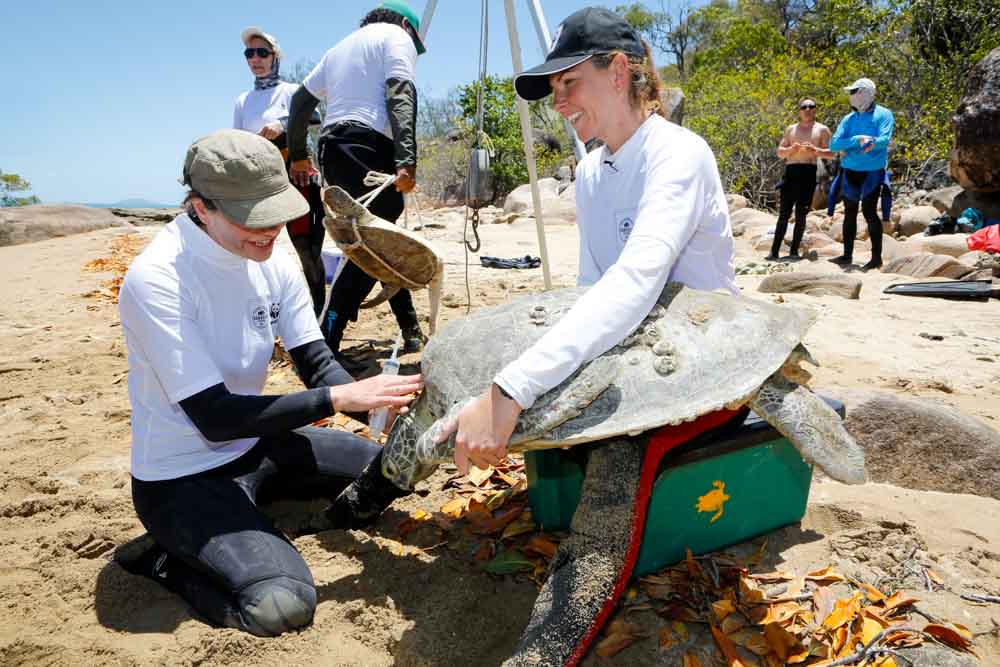
The Great Barrier Reef is like no other place on Earth and a refuge for some of our most magical creatures. With the support of the Banrock Station Environmental Trust, WWF-Australia and its partners are conducting pioneering research to protect the Reef's precious residents, like marine turtles.
Living as they do in coastal bays, green turtles are directly impacted by human activity. What we put down our sinks, the chemicals we use on land and what’s washed off our roads ends up in the ocean, threatening the clean water that turtles need to survive.
During flooding, massive amounts of soil and chemicals are washed from farms, industrial and urban areas onto the Reef. This pollutes and destroys areas of seagrass and coral, where turtles live and feed, and has been implicated in unexplained mass turtle deaths and higher rates of disease.
Our Rivers to Reef to Turtles project aims to identify and measure the key pollutants in rivers, the Great Barrier Reef and in green turtles themselves. Then we can work to improve water quality, boosting the resilience of the Reef and turtle health.
WWF’s project partners include the University of Queensland’s National Research Centre for Environmental Toxicology and School of Veterinary Science, James Cook University’s Centre for Tropical Water and Aquatic Research, Griffith University, the Great Barrier Reef Marine Park Authority, Queensland Government agencies, local Traditional Owners and natural resource management groups, and community members.
What our partners say...
“This new partnership is an incredibly rewarding opportunity to support WWF-Australia in an effort to understand the threats to one of the most iconic Australian ecosystems and its native marine wildlife, and help to find solutions to protect it,” said Dr Christophe Tourenq, Banrock Station Wetland Manager and Banrock Station Environmental Trust panel member.
“We’re investigating which contaminants are in Reef waters, to what degree green turtles are absorbing these contaminants, and how that might be impacting turtle health,” said WWF-Australia’s National Manager for Species, Darren Grover. “Turtles are a good barometer of Reef health and the contaminants affecting them are also likely to be impacting other marine creatures."
“There used to be a theory that the ocean was so huge it would dilute contaminants to such an extent that it remained a relatively healthy environment for marine creatures,” said Associate Professor Caroline Gaus, from the University of Queensland. “But people should be aware that many of the chemicals we flush down the toilet, apply to our gardens, spray on crops, or use in factories can end up in turtles and we don’t yet know how it is affecting them."
“We found chemicals associated with industry and agriculture in the blood of turtles from both Upstart Bay and Cleveland Bay,” said Associate Professor Gaus. “But the preliminary data highlights that Upstart Bay turtles have particularly higher levels of the metals cobalt, molybdenum and antimony, and higher levels of stress-related compounds than turtles at the other locations. These stress-related compounds are often a sign of chemical exposure."
Timeline of action
Project commenced in mid-2014
Fieldwork commenced at the control site in the Howick Group of Islands in August-September 2014
Fieldwork in Cleveland Bay and Upstart Bay commenced in October 2014
Next round of fieldwork in Cleveland Bay and Upstart Bay was in June 2015
Next round of fieldwork at the Howick Group of Islands was in July-August 2015
First round of results shows clear differentiation in the water quality between ‘control’ and ‘impacted’ sites, while turtles from the Howick Group appeared to be the healthiest
Further fieldwork in Cleveland Bay and Upstart Bay was in September-October 2015
Another round of fieldwork in Cleveland Bay and Upstart Bay was in May 2016
Last round of fieldwork at the Howick Group of Islands in July-August 2016
Latest updates from the project
Final Report – Rivers-to-Reef-to turtles – 2018
PDF 9.8 MBChemical pollution on the Great Barrier Reef
PDF 3.11 MBRivers to Reef to Turtles final report
PDF 9.8 MBRivers to Reef to Turtles Scientific Report summary
PDF 657.93 KBRivers to Reef to Turtles Update 15- June 2017 (Cleveland Bay)
PDF 613.84 KBRivers to Reef to Turtles Update 14 - May 2017 (Upstart Bay)
PDF 590.91 KBRivers to Reef to Turtles Update 13 - November 2016 (Cleveland Bay)
PDF 585.58 KBRiver to Reef to Turtles Update 12 - October 2016 (Upstart Bay)
PDF 699.33 KBRivers to Reef to Turtles Update 11 - August 2016 (Howicks)
PDF 1.4 MBRivers to Reef to Turtles - Annual Report 2016 (Year 2)
PDF 1.71 MBThis form could not be loaded. Please check the configured form URL.