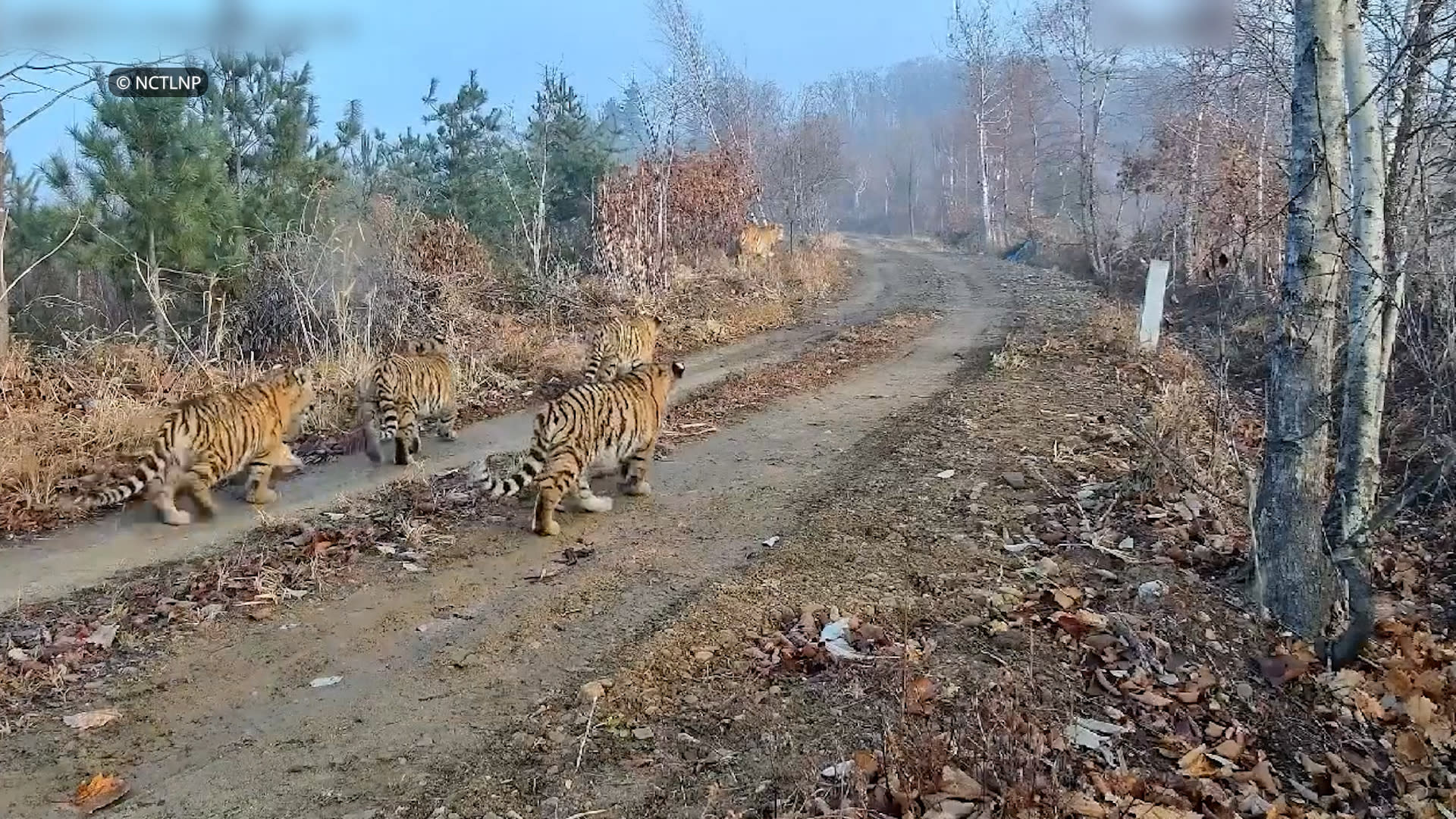
In November 2025, something extraordinary happened in northeast China. For the first time ever, an Amur tigress was filmed on a sensor camera with five cubs in China. Wild Amur tigers typically give birth to one to four cubs, making five cubs an exceptionally rare occurrence even in regions with abundant prey.
Repopulating China’s tiger landscapes
The Northeast China Tiger and Leopard National Park, which is the world’s largest protected area for tigers, sits along the international border of China and Russia and is a vital corridor for Amur tiger dispersal. This landscape connectivity will be crucial for these cubs to move away from their mothers once mature enough to establish their own territory.
But where tigers roam, risks follow. Human-wildlife conflict, poaching, and habitat management remains a challenge. WWF-China is supporting the Northeast China Tiger and Leopard National Park and local communities to:
Remove snares and prevent poaching
Implement SMART patrol systems
Develop human-wildlife conflict management strategies
Strengthen community participation in co-management
Increase tiger prey populations
Protecting people
China’s tiger population has increased from an all-time low of 20 in 2010, to around 70 in 2025. Because of this, many communities living in northeast China today haven’t lived in close proximity to tigers before, creating a generation gap in past knowledge and experience. In response to this, WWF-China has been supporting the government with human-tiger coexistence strategies, known as the Conflict to Coexistence Approach, in anticipation for an increase in tiger population in the region.
Part of this approach included building five real-time alert cameras surrounding connecting roads that lead to villages in the buffer zone of the Northeast China Tiger and Leopard National Park, close to where the Amur tigress and cubs were recorded. When a tiger passes by, the system sends instant notifications to rangers’ mobile devices. Rangers then share early warnings via village committees and WeChat groups, helping residents avoid risk. These cameras are having a significant reduction in human-wildlife conflict and have so far delivered 98 alert messages.
Protecting tigers
Alongside people, tigers also need to be kept safe. An increase in tiger populations can bring the risk of poachers, looking to poach and sell tiger parts and products in the global illegal wildlife trade. In anticipation of this, WWF-China has been supporting its government partners by establishing three community patrol teams in this area, each with four local rangers. In 2025 alone, they:
Conducted 624 patrols
Covered 11,112km (equivalent to 265 marathons!)
Logged 12,323 patrol hours
Removed 123 snares
Recorded 1,230 traces of wildlife
A Future Full of Hope
Each cub is a living testament to impact of years of conservation efforts. Seeing five cubs in this landscape is a huge win for conservation and shows that these forests are doing their job—providing food, space, and safety for one of the world’s rarest big cats.
WWF-China will continue to work closely with the government and community partners to strengthen conservation measures, improve habitat connectivity, and ensure that tiger recovery remains a national and global success story.
Symbolically adopt a tiger today to help protect them from extinction. Your monthly donations will symbolise your support for conservation and animal advocacy, and ensure tigers remain part of our environment forever.